
ncs

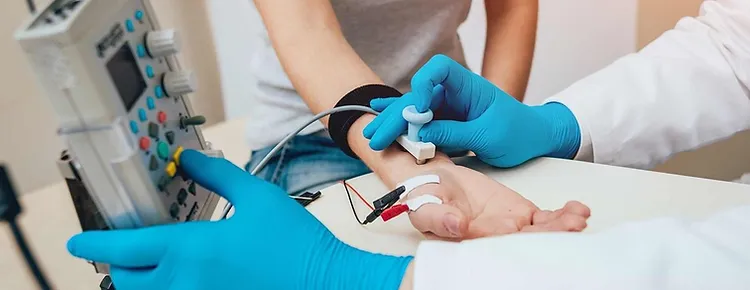
EMG and Nerve Conduction Studies

We offer full medical consultations followed by electrodiagnostic studies for the evaluation of neuromuscular symptoms. ​As a form of functional testing, this is complimentary to diagnostic imaging, with greater specificity.

Why do Electrodiagnostic Testing?

When disease of the peripheral nervous system is suspected, electrodiagnostics can help determine:

Diagnosis:

CNS, MND, root, plexus, mononeuropathy, polyneuropathy, NMJ, muscle,

Timing of injury:

<1 week, 1-2 weeks, 2-6 weeks, >6 weeks

Severity of injury:

Demyelination or axonal, and percentage loss

When disease of the peripheral nervous system is suspected, electrodiagnostics can help determine:

Estimating prognosis:

Motor unit recruitment demonstrates axonal continuity

Monitoring injury:

Testing at different intervals can demonstrate recovery or worsening

Surgical planning:

Carpal tunnel release, ulnar nerve transposition, nerve transfer/grafts, spinal canal decompression, thoracic outlet decompression

Common Symptoms

"Negative" Symptoms

"Positive" Symptoms

Motor Nerve

  • Weakness
  • Decreased Muscle Tone ("floppy")
  • Decreased Muscle Bulk
  • Orthopedic Deformities
  • Decreased Reflexes
  • Muscle Cramp ( "Charlie Horse" )
  • Increased Muscle tone ("stiffed")
  • Muscle Fasiculations ("twitching")
  • Muscle Fasiculations ("twitching")
  • Restless Legs

Sensory Nerve , Large Fiber

  • Decreased Vibration/Proprioception Sense
  • Decreased Muscle Tone ("floppy")
  • Decreased Reflexes/Proprioception Sense
  • "Tingling"
  • "Burning"

Sensory Nerve , Small fiber

  • Decreased Pin-Prick Sense
  • Decreased Temperature Sense
  • "Shooting"
  • "Burning"

Motor Nerve

Sensory Nerve , Large Fiber

Sensory Nerve , Small fiber

EMG Advantages and Limiting Factors

Advantages

  • • Only laboratory study that directly assesses the physiologic integrity of the roots , thereby providing both diagnostic and prognostic relevance
  • • Objective : May reveal changes consistent with a root lesion in the presence of a normal/unsatisfactory physical exam
  • • The EDX evaluation may be abnormal when all other laboratory procedures, including neuroimaging studies, are unrevealing. EDX is therefore helpful with non-compressive radiculopathies, when imaging is inconclusive
  • • With definite compressive root lesions, EDX can determine the severity of the axon loss, helping to gauge the relevance of any positive imaging findings
  • • EDX can identify extraforaminal lesions e.g. plexopathies, mononeuropathies, polyneuropathies, the symptoms of which are often attributed incorrectly to radiculopathies
  • • When performed by experienced physicians, EDX studies are rarely false positive. In contrast, incidental neuroimaging abnormalities are very common, particularly in the middle-aged or elderly patients without related symptoms. Consequently, EDX studies may be helpful in determining whether the imaging is of clinical significance
  • • EDX studies have a low morbidity

Limiting Factors

  • • Does not detect all compressive radiculopathies. EDX cannot be used to exclude a radiculopathy.
  • • When a radiculopathy is suggested, the etiology cannot be determined.
  • • When a specific root appears to be involved, various anatomic factors may lead to inaccurate localization, so the affected root is not recognized (usually the one adjacent)
  • • Confounding actors: patient age, diabetes mellitus, generalized polyneuropathy, remote poliomyelitis

Ready to reclaim your active lifestyle?

Please see our fees and financing for more information.

755 Queensway East

Mississauga ON L4Y 4C5

REHABILITATION SERVICES

Unit 303: Physiotherapy, Massage Therapy,
Chiropractic, Custom Bracing, DEXA Body Scans

Mon, Wed, Fri : 8 am to 7 pm
Tues, Thurs : 8 am to 5 pm
Sat to Sun : Closed

MEDICAL SERVICES

Unit 303: Rheumatology, Neurology, Psychiatry, Lifestyle Medicine
Unit 304: Physical Medicine, NCS/EMG, US-Guided Injections

Mon to Fri : 8 am to 5 pm
Sat to Sun : Closed
(Hours and availability may vary)

Book Therapy